A Simple & Powerful Stress Coping Tool
Jan 30, 2022
Clients often ask for help managing stress. Most people can identify what’s creating their tension—conflict, parenting, relationships, finances, work, health—but they struggle to use that awareness in a way that actually helps them cope.
A significant amount of stress comes from investing our energy in things we can’t control or change. When you intentionally focus on what you have direct influence over, your stress decreases.
Before I share the tool, let's look at the negative impact of stress. Recognizing how stress damages your life will motivate you to take action.
Stress & Anxiety Can .......
- Decrease your ability to solve problems
- Make decision-making difficult
- Trigger mental health issues like depression, anxiety, OCD, and ADHD
- Lead to destructive coping mechanisms (e.g., alcoholism, gambling, overeating, etc.)
- Lead to serious health problems (e.g., asthma, heart disease, diabetes)
- Decrease your creativity
- Leave your immune system less effective in fighting off illness
12-step meetings like Al-Anon and Alcoholics Anonymous frequently refer to this concept. Grandmas have lectured grandkids about this for centuries.
"God grant me the serenity. To accept the things I cannot change; Courage to change the things I can; And wisdom to know the difference." ~ Reinhold Neibuhr
The Tool: Focus on What You Can Influence
Step 1
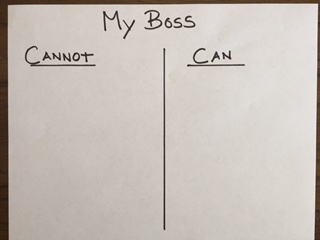
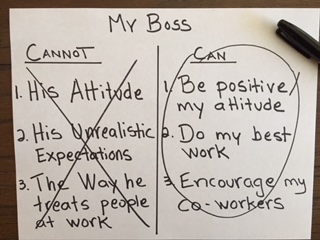
Write the name of your stressor at the top of a sheet of paper (for example: money, parenting, traffic). Draw a line down the center of the page to divide it in half. At the top of the left column, write and underline CANNOT. At the top of the right column, write and underline CAN.
Step 2
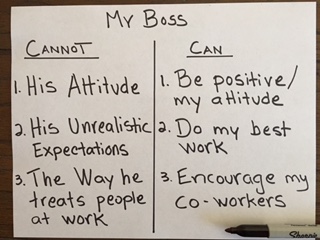
On the left side, under CANNOT, list three aspects of the situation that are outside your control. Under CAN, list three things you can influence related to your stressor. Identifying what you can change takes courage. If you get stuck, ask a trusted friend for their perspective—they may see options you’re missing.
If this was helpful, SUBSCRIBE TODAY and get instant access to my free video and worksheet: Shatterproof Yourself — 7 Small Steps to a Giant Leap in Your Confidence.
Step 3
Draw an X through everything listed under CANNOT. This is where stressed-out people spend about 90% of their energy. Now circle everything under CAN. Commit to focusing at least 80% of your time and energy there, and you’ll notice your anxiety begin to decrease.
Step 4
You identified three action items. Now schedule time to complete each one. Better yet, choose one and take action on it today. When this stressor starts to take over again, return to this worksheet. It will help you reset your focus and get your thinking back on track.
Click here to get a fillable pfd worksheet on this topic. Feel free to give it to friends and/or use it with your own clients
Writing your thoughts down is powerful. What feels fuzzy in your head becomes clear on paper. You gain perspective and begin to see what’s actually within your control—your actions and your mindset. Make this tool a habit, and it will consistently help you think more clearly.
Related Content
3 Keys to Lowering Anxiety by Adam Gragg
What to Do When Emotionally Overwhelmed by Adam Gragg
Overcome Worry & Get Out of Your Head by Adam Gragg